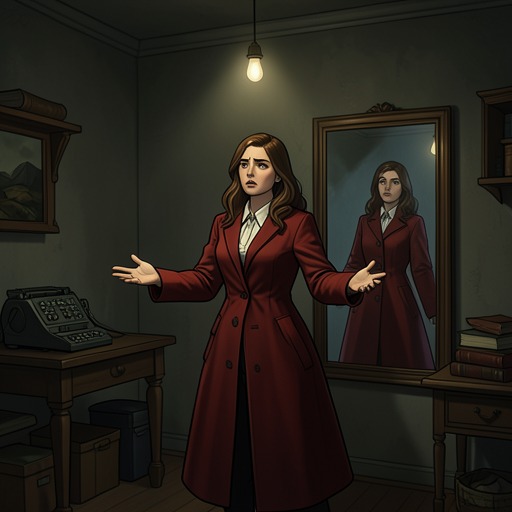
Camille D’Artigo
Tales From Otherworld: Collection OneCamille D’Artigo is a half-Fae witch whose life on Earthside is defined by the uneasy coexistence of formidable identity and unreliable magic. These scenes place her in the bookstore, the household kitchen, the herb garden, and the grounds around Birchwater Pond, showing how supernatural crises and ordinary responsibilities continually overlap. Her decisive significance lies in that overlap: she can confront danger, organize a household, recognize trauma in others, and search for family history, yet she is also bored, angry, embarrassed, lonely, and vulnerable to the consequences of spells she cannot fully control.
Identity and Background
Camille D’Artigo’s recalled adventures take place after the D’Artigo sisters have come to Earthside but before Witchling begins. She is a witch who has spent years trying to master an invisibility spell, while knowing that her magic backfires often enough to make magical practice economically and emotionally exhausting. Her Earthside life includes running The Indigo Crescent, her bookstore, a role that places her at the intersection of commerce, community, and occult experimentation.
Her half-Fae heritage gives her a natural effect on humans. The narrative treats this allure as an inherited power rather than a behavior she deliberately deploys, but it also shows how quickly that power can become socially uncomfortable. When a young customer stares at her body instead of her face, Camille understands that being half-Fae means affecting humans, yet she refuses to accept his conduct as an unavoidable consequence of her nature. Her identity therefore produces both influence and exposure: she can command attention, but she must also defend her bodily boundaries when that attention becomes objectifying.
Magic, Work, and the Invisibility Mishap
The bookstore episode begins with unusually poor business. Sunny weather in Seattle has drawn people outdoors, leaving The Indigo Crescent empty, and by midafternoon Camille is hot, tired, and profoundly bored. Rather than treating the quiet as rest, she uses it as an opportunity to test spells that have repeatedly failed. She chooses a non-offensive charm because she does not want to damage the shop, retreats to the back hall, and casts the spell without components.
The spell is the “By the powers of three times three” invisibility spell, which has previously produced only a fizzle and nothing more. This time it succeeds in the wrong way. Camille’s clothing becomes invisible while her body remains visible, creating a reversal that transforms a private magical experiment into a public spectacle. The problem is not merely that the spell works imperfectly; it exposes the gap between magical intention and practical consequence. Her clothes, rather than her person, disappear, making the spell useless for concealment and immediately dangerous to her dignity.
About twenty minutes later, a young man enters The Indigo Crescent and heads toward the science-fiction section. When he turns to ask for help, he cannot speak because his attention is fixed on Camille’s breasts and then moves lower. Camille knows that her half-Fae nature affects humans, but the intensity of his response disgusts and unsettles her. She confronts him directly, demanding, “What’s the matter? Can’t see my face?” The question is both a rebuke and a demand that he recognize her as a person rather than as an arrangement of exposed body parts.
Iris’s arrival changes the meaning of the confrontation. Camille initially assumes that Iris is interrupting a lesson in manners and tells her to wait, but Iris’s horror and embarrassment reveal that Camille does not yet understand what has happened. The scene’s comic surface therefore depends on delayed recognition: Camille interprets the customer’s behavior as an extreme response to her allure, while Iris recognizes the magical disaster. Camille’s authority in the shop is temporarily undermined by her inability to see the condition of her own clothing.
The spell eventually takes a full week to wear off. Its consequence is not simply embarrassment but a durable change in Camille’s behavior: she decides to leave invisibility to someone else. The lesson is practical and pointed. A closet full of beautiful clothes has no value to her if nobody can see them, and the failed spell converts a long-standing magical ambition into a reason for restraint. Her magic remains part of her identity, but mastery is measured here by knowing which powers not to use.
Household Authority and Everyday Responsibility
Camille’s role within the D’Artigo household is equally important. In the Thanksgiving scene, she participates in an enormous preparation effort involving Iris, Hanna, Delilah, Trillian, Rozurial, and Vanzir. Iris directs the work while Hanna acts as her lieutenant, and Camille describes the remaining members of the household as soldiers receiving orders. Camille is therefore not the sole center of authority, but she is a visible participant in a cooperative domestic structure whose labor is organized through personality, competence, and argument.
Her specific task is baking. She removes cherry pies from the oven, with eight pies occupying the large double oven, two per sheet. The household has already prepared eight pumpkin pies and still plans to make eight apple pies. With sixteen people expected at the table, including newly discovered cousins, the quantity is treated as barely sufficient because everyone has unusually large appetites. The numerical abundance turns domestic work into a form of logistical planning: Camille’s magic and heroic identity do not exempt her from ovens, pastry, timing, or the physical scale of feeding a large supernatural family.
The same domestic setting exposes the household’s capacity for chaos. Smoky returns carrying a turkey weighing roughly twenty-five pounds, but the bird is still alive and violently resisting capture. Camille jumps back when it attacks the buckles on her boots and objects that the animal cannot be cooked in its current state. The incident places her practical judgment against Smoky’s enthusiasm and makes the household’s holiday preparation depend on negotiation with a living animal rather than on a simple trip to a store. Her reaction is immediate, concrete, and grounded in responsibility: the problem is not whether the turkey is impressive, but that it is alive.
A later scene shows Camille carrying responsibility beyond cooking. After Trillian abruptly leaves for Otherworld, she becomes angry and considers withdrawing to Lake Y’Leveshan or visiting the Grove of the Moon Mother. Instead, Delilah gives her the household notebook and asks her to plan repairs and replacements before the rainy season. Iris is close to having twins, Hanna cannot yet manage the household because she does not know enough about running the place and cannot read English, and Camille is consequently expected to assume more organizational work. Her frustration coexists with competence; even while she feels neglected by her husbands, the household turns to her because practical continuity depends on her.
Trauma, Memory, and Care
Camille’s history is also present in the trauma of other characters. Hanna’s sleepwalking episode reveals that Hanna cannot escape the memory of Kjell’s death. In her waking dream, Hanna pleads for her son’s forgiveness and asks him to understand why she acted as she did. The source of that guilt is known because Camille previously told the household what happened: Hanna helped Camille escape Hyto’s lair, tended Camille’s wounds, and helped her survive the aftermath of torture before saving her own son by ending his life when there was no other choice.
Camille is therefore not merely a survivor whose suffering remains private. She is also the person who makes the truth of Hanna’s sacrifice narratable to the family. Her testimony links two forms of trauma: the torture inflicted on Camille by Hyto and the irreversible decision Hanna made while helping her. By telling the story when she is finally capable of speaking about her ordeal, Camille creates the knowledge that allows others to understand Hanna’s nighttime guilt. Her recovery is thus connected to the household’s collective memory, even though the revelation does not erase Hanna’s pain.
The episode also shows how Camille’s experience changes the emotional architecture of the home. Hanna’s guilt drives her from sleep into a waking dream, while Rozurial responds by lowering his weapon, approaching quietly, and leading her to safety. Camille’s earlier account is the unseen cause of the reader’s understanding: without it, Hanna’s words would be mysterious; with it, they become the return of a burden carried since the rescue. Camille’s role is consequently both active and retrospective, shaping scenes even when she is not physically present.
Nature, Seasons, and the Wider Network
Camille’s relationship with place is especially visible in the herb garden and the path to Birchwater Pond. After Trillian’s departure, she tends the magical herbs that must remain within the circle where they were planted until harvest. She kneels beside the mandrake and greets it, then considers composting the perennials before the rainy season and first frost arrive. This is a practical form of magical stewardship: the garden requires seasonal knowledge, protection, and patient maintenance rather than spectacular spellcraft.
The landscape also contains the memory of Hyto’s violence. Passing the place where he captured her makes Camille shudder as unwanted memories return. Smoky and the other men have cut down the trees Hyto’s father destroyed and planted rose bushes in their place, a deliberate attempt to replace traumatic associations with living beauty. The roses do not immediately comfort Camille, and Trillian’s idea does not erase what happened, but their scent interrupts the memory long enough for her to breathe, listen to birdsong, and continue. Recovery is represented not as forgetting but as learning to move through a damaged place that has been replanted.
At dusk, Camille approaches Birchwater Pond and discovers unexpected lights in the grotto. The site normally contains picnic tables, benches, and a shelter for rituals and holidays, but there should be no one there at that season. She considers eye catchers and will-o’-the-wisps, including the possibility of another dangerous infestation, before hearing music from one of her favorite softer bands. The music supplies a mundane clue inside a supernatural setting and turns suspicion into anticipation. Camille’s caution remains essential, but so does her willingness to investigate rather than retreat.
The pond also connects Camille’s domestic life to the seasonal supernatural order represented by Hi’ran and the Harvestmen. In the autumn scene, Delilah and Shade sit beside a bonfire at Birchwater Pond while Hi’ran is felt in the trees, flames, and cold air. Camille is not the viewpoint character there, but the setting belongs to the same shared environment she cultivates and uses for rituals. The recurring pond, fire, garden, and changing weather create a network of places where private relationships, household duties, magic, and seasonal power meet.
Relationships and Narrative Role
Camille’s relationships are defined by density rather than isolation. Iris can interrupt her confrontation with a customer and redirect her attention; the same Iris organizes the Thanksgiving kitchen and is nearing the birth of twins. Hanna depends on the household’s support while carrying the memory of Kjell, yet she also once cared for Camille after Hyto’s torture. Delilah summons Camille back from the path to the pond and later shares the family’s domestic and supernatural life. Trillian’s abrupt departure wounds Camille precisely because marriage has created expectations of consideration, while the household’s ongoing needs prevent her from simply abandoning responsibility.
Her marriages also produce an internal contradiction. Camille wonders why she married at all, including her relationships with all three husbands, when they are behaving inconsiderately. She imagines going to Otherworld alone, camping beside Lake Y’Leveshan, reading, and visiting the High Priestess Derisa in the Grove of the Moon Mother. Yet the fantasy of escape is interrupted by the household notebook and the approaching rainy season. Camille’s freedom is real enough to imagine, but her position within the family repeatedly draws her back into care, planning, and shared survival.
Across these scenes, Camille functions as a bridge between kinds of experience that the narrative refuses to separate cleanly. She is a witch whose spell can fail in comic fashion, a half-Fae woman forced to police the gaze of a human customer, a baker working within a sixteen-person holiday household, a survivor whose testimony clarifies another woman’s guilt, and a gardener reading weather and tending magical plants. Her power is therefore not presented as flawless control. It is a negotiated capacity, continually tested by bodies, seasons, memory, family, and the material world.
Camille’s most revealing pattern is the movement from reaction toward deliberate recognition. She first reacts angrily to the customer, only later learning that the invisibility spell caused the spectacle. She initially responds to Trillian’s departure with fantasies of leaving, then accepts the notebook and the practical demands of the house. She is startled by unexplained noises and lights, yet investigates the path and grotto carefully. These reversals make her a rounded character: decisive but not omniscient, powerful but fallible, capable of anger without being defined by it, and repeatedly forced to convert surprise into judgment.